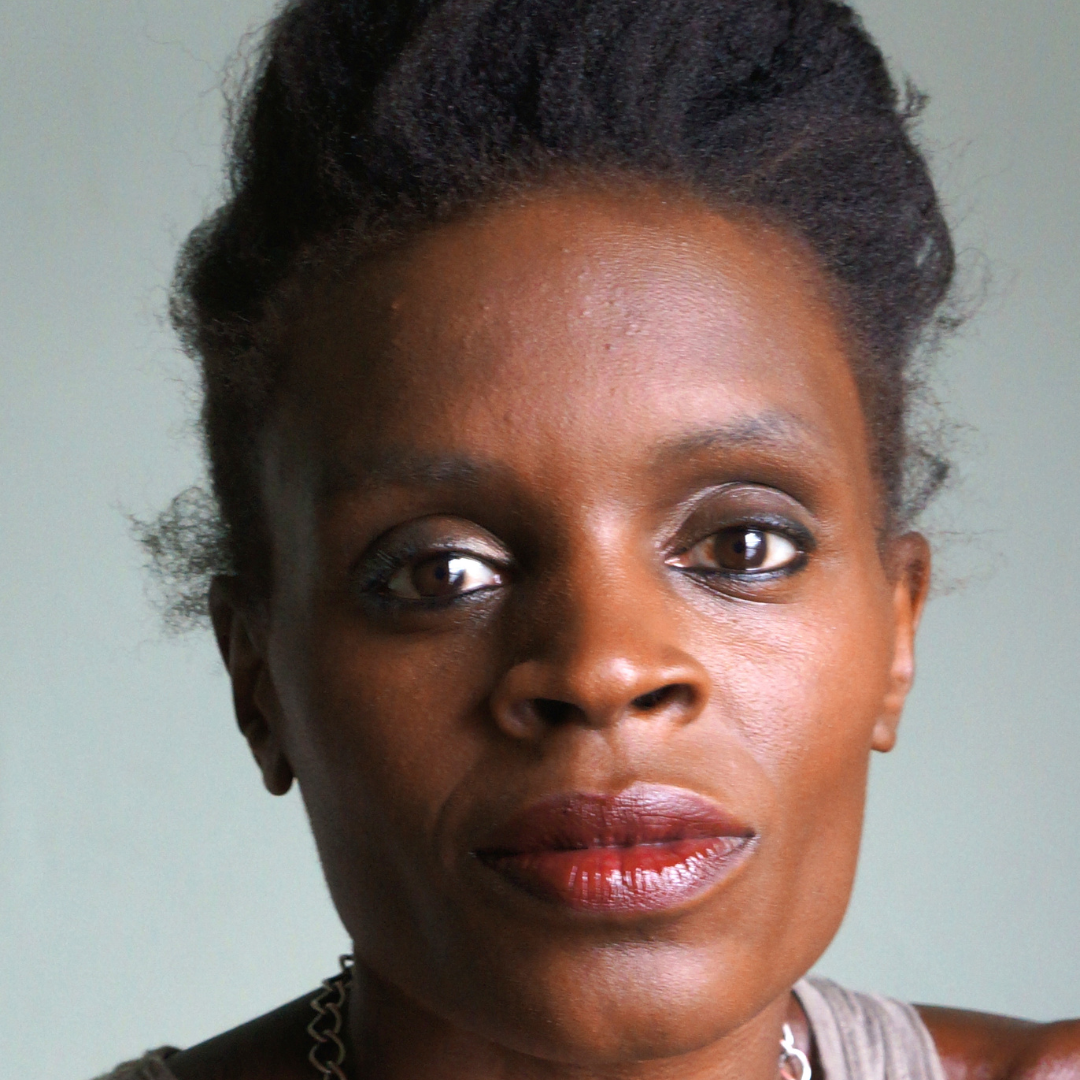
Okwui Okpokwasili
(NY)
2012, 2016
- Okwui Okpokwasili is a performer and writer based in Brooklyn, NY. She works across performance disciplines and genres.
read more
She wrote, choreographed and performed in a run of her original work, Pent-Up: A Revenge Dance at PS 122 for which she received a 2010 Bessie Award for Production. Described as “ruthlessly clean and clever” by Helen Shaw of Time Out NY, Pent-Up is an exploration of cross cultural collisions. A mother and daughter attempt to construct identity out of fragments and memory, through competing narratives and broken gestures. The New York Times has described her as “incandescent”.
Her work in multidisciplinary performance is best exemplified by her ongoing artistic collaboration with Ralph Lemon, the Bessie Award winning Artistic Director of Cross Performance. She just completed the 2010 tour of his latest work How Can You Stay… In January of 2011 performed a duet with Ralph in the Atrium at MOMA as part of the exhibit , On Line: Drawing Through the Twentieth Century. Okwui also received a Bessie Award for her performance in the final part of Ralph Lemon’s Geography Trilogy, Come Home, Charley Patton.
For the 2008 Prelude Festival , she and frequent collaborator Peter Born created an installation where she placed herself in a pitch dark box that mimicked the makeshift shacks of roadside dwellers in Nigeria. Audience members were led inside one at a time to be with her alone in complete darkness as a narrative unfolded onstage about a missionary’s failed conversion effort and entanglements in a village in West Africa. This installation was concerned with disrupting received narratives about Africa, and the persistence of the conflation of fetish objects and African bodies in the Western imagination. They attempted to replace the act of looking at an “African” object with the act of breathing with an unknown, unseen figure in the darkness and making a space for the viewer’s inward reflection. This also served as an extension of thematic concerns surrounding Pent-Up: A Revenge Dance.
She also performed in the Dean Moss/Laylah Ali collaboration, Figures on a Field, which premiered at the Kitchen in the spring of 2005, and went on to Mass MoCA in 2006. She was an early collaborator on Democracy in America, which premiered at PS 122 in 2007 under the direction of Annie Dorsen, director of the critically acclaimed Passing Strange.
In 2006 she was selected as a FUSED- French US Exchange in Dance – artist, where she was given a three month residency to develop Pent-Up: A Revenge Dance through Centre National de la Danse in Pantin, Paris.
Acting roles in NYC include: “Leda” in SOUNDING directed by Kristin Marting at HERE Arts Center, “Goneril” in Young Jean Lee’s LEAR at Soho Rep, “Joan” in JOAN DARK co-produced by The Goodman Theater and the Linz 2009 European Capital of Culture, “Long Legged Ballerina” in Richard Foreman’s Maria Del Bosco, “Madame Laramie” in Richard Maxwell’s Cowboys and Indians, “Hilde” in Nomad Theatrical Company’s The Master Builder under the direction of Victoria Pero and “Othello” in Donna Linderman’s Oth at Dixon Place. In Williamstown Theater Festival’s Act I Company, she played “Constance Fletcher” in Gertrude Stein’s The Mother of Us All. Film roles include “O” in Knut Asdam’s ABYSS, the “Nigerian Tour Guide” in Sydney Pollack’s The Interpreter , “Malika” in Lasse Hallstrom’s 2006 release The Hoax and CGI stuntwork as one of the infected in Will Smith’s I Am Legend.
She is a Randjelovic/Stryker Resident Commissioned Artist for New York Live Arts. As well as the recipient of the 2016 Lower Manhattan Cultural Council President’s Award for Performing Arts. Recently she completed the performance installation, “when I return who will receive me?” at the Lower Manhattan Cultural Council’s 2016 Rivier to River Festival.
Poor People’s TV Room
Returning Choreographic Fellow | July 1 – 19, 2016 | September 18 – October 10, 2016
Collaborators in Residence: Peter Born (Director/Designer), Thuli Dumakude, Katrina Reid, Nehemoyia Young (Performers)
Bessie Award-winning artist Okwui Okpokwasili uses an interdisciplinary, intensely visual and textured lens to look at issues of gender, culture, and identity as they are expressed in American and global contexts. Poor People’s TV Room is rooted in a kinetic history of collective action in Nigeria, drawing from historical events in order to explore the amnesia around collective action initiated by African women and to build a narrative around the impact of that erasure. Integrating choreography, song, text, and film, Poor People’s TV Room crosses disciplines to make a visceral performance where the past is alive and unleashed in the present.
Poor People’s TV Room is informed by two historic incidents in Nigeria: The Women’s War of 1929, a resistance movement against British colonial powers; and the Boko Haram kidnappings of more than 300 girls, which launched the Bring Back Our Girls movement. Women have been central to these campaigns and have played essential and powerful roles in Nigeria’s independence. Poor People’s TV Room attempts not only to unearth this complex history, but to investigate how buried narratives of women in Nigeria resonate with present actions throughout the world.
Other creative points of departure include: the dystopian mythology of author Amos Tutuola; Octavia Butler’s science fiction; the TV room of a wealthy government official designated exclusively for poor people in his village; a lost girl in the present; and a ghost from the Women’s War.
Performed by Okpokwasili and a cast of three women from different generations, the choreography and music are inspired by traditional Nigerian songs and dances that were performed by women as acts of resistance and blended with Okpokwasili’s own contemporary aesthetic. Collaborating with director/designer Peter Born, the visual design reflects their work at the intersection of theater and installation to achieve a visceral and encompassing environment.
The MANCC residency was the first time in the year-long development of the work that the whole cast was in the same room at once, allowing the collaborators to develop a movement vocabulary and framework for the piece, and also experiment with live feed video and projections. Okpokwasili returned to MANCC in September 2016 for a second residency to continue the development of Poor People’s TV Room.
This residency was made possible, in part, by The Andrew W. Mellon Foundation.

Bronx Gothic
Choreographic Fellow | November 2 – 20, 2012
Collaborators in Residence: Peter Born [filmmaker/videographer], Onome Ekeh [advisor]
Okwui Okpokwasili, who had been in residence previously with Ralph Lemon, returned to MANCC as a Choreographic Fellow to develop a new performance piece framed within both an oral storytelling tradition that recalls the griot of West Africa and Victorian gothic novels. While in residence, she explored the following thematic questions: assumptions and expectations that come with an “African” or “African American” subject/body, the possibilities of interchange between the performer and audience, how the performance space could be designed to reflect an intimacy that is inviting but slightly unsettling, and the ways in which she might build a one woman performance piece that interrogates the possibilities and the limitations of this particular framework.
Okpokwasili used the residency to generate a movement vocabulary with support from artist and producer Onome Ekeh, who served as an advisor during the residency. Along with developing the physicality of the piece, she also met with FSU Religion scholar, Dr. Joseph Hellweg to examine the work of Malian artist Rokia Traore, investigating the score of songs and sound that shape the world of the piece. FSU School of Dance students were invited to observe and discuss the new work towards the end of the residency.